The New Frontline: Natural Resources
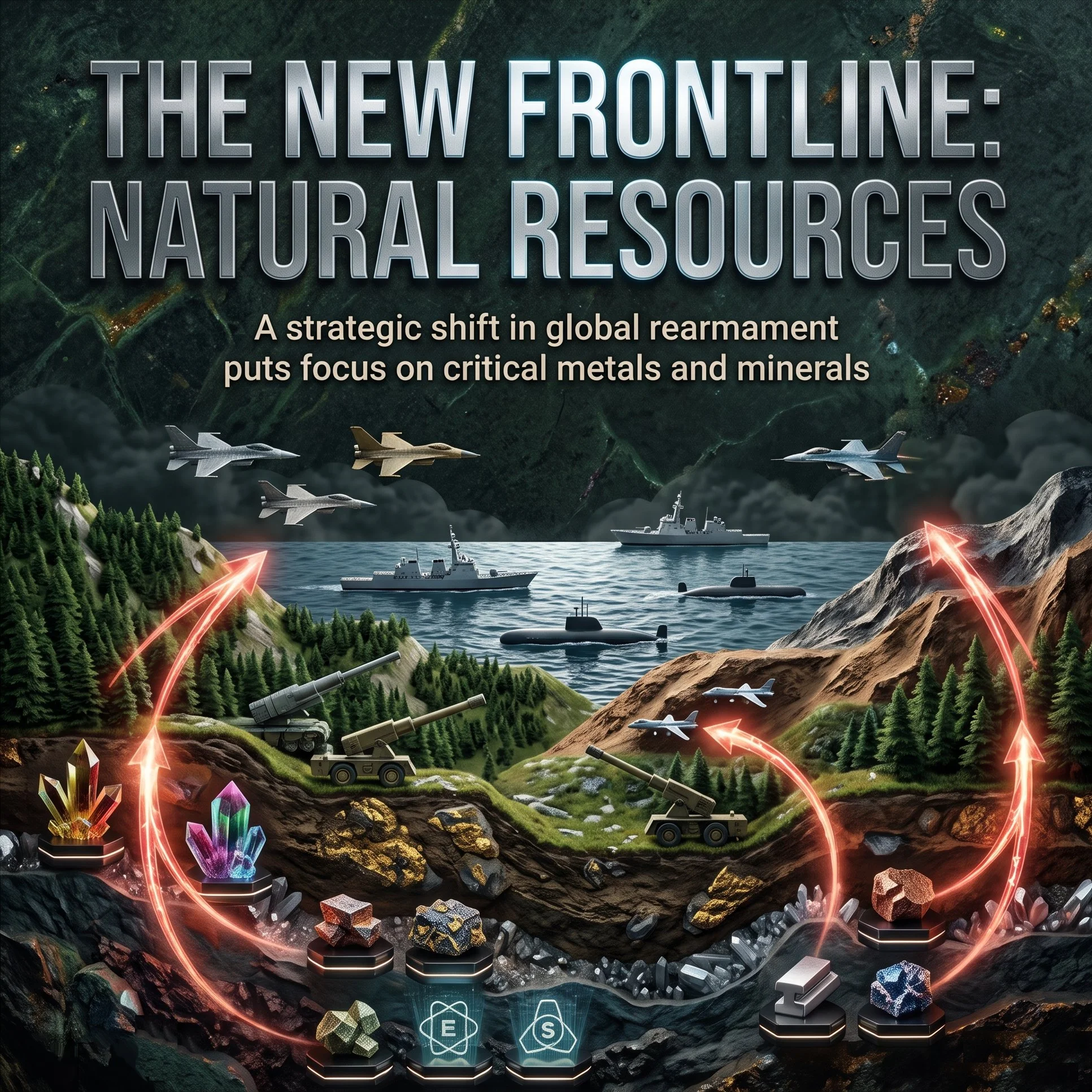
For three decades following the Cold War, Western nations allowed their military manufacturing bases to quietly decay. Munitions stockpiles were sold off, shipyards fell silent, and defense budgets shrank. But the era of disarmament has come to a screeching halt.
As geopolitical tensions flare, the West is launching its largest military buildup in decades. Owning the stock in defense contracting companies is one way to invest in this theme, but we prefer a different approach–one that may offer a more attractive risk/return scenario.
Over lunch last week, a colleague at VanEck, sponsor of the VanEck Rare Earth and Strategic Metals ETF (REMX), shared some of the firm’s research and made a compelling case for investing in companies producing, refining, and recycling rare earth and strategic metals.
The Rearmament Surge
Modern warfare relies on raw materials, and the sudden rush to rearm is facing a critical bottleneck: a shortage of essential metals and minerals, many of which are controlled by China. After decades of decline, defense spending is accelerating rapidly.
World defense spending jumped nearly 10% in real terms in 2024, reaching $2.9 trillion in 2025. At NATO's 2025 Summit, member states pledged to increase defense spending to 5% of GDP by 2035—more than double the previous target. In the U.S., the Department of Defense has requested $1.5 trillion for defense in 2027—a 44% increase over 2026, which would be its largest military buildup since World War II.
According to the Financial Times, Germany plans to borrow more than €800 billion ($912 billion) by 2030, breaking with decades of fiscal restraint to bring defense spending to levels not seen since the Cold War. Next year alone, Chancellor Friedrich Merz’s government plans to raise more than €200 billion from markets, 12.5% more than this year. Germany’s defense budget is set to reach €109 billion next year and €183.6 billion by 2030.
When defense budgets expand this rapidly, money shifts from paying personnel to purchasing physical equipment—jets, submarines, artillery, missiles, and drones. That hardware requires vast quantities of physical resources.
The Metals Supercycle
We have seen this pattern before. During World War II and the Korean War, the United States faced severe shortages not of soldiers or assembly lines, but of core metals like copper, steel, aluminum, and tungsten. By 1950, material shortages were so acute that Washington had to barter agricultural goods to secure foreign ores.
The availability of raw metals will set the speed limit for national defense. A fighter jet and a naval destroyer will never cross paths on the battlefield, but they compete for the exact same pool of raw materials. As rearmament ramps up, military procurement is increasing demand in several key commodity markets including high-grade and specialty steel, copper and aluminum.
The Structural Bottleneck: China Dependency
The structural bottleneck is further complicated by where these materials originate. China currently holds a dominant position over the supply chains of several materials critical to defense manufacturing.
High-performance magnets made from samarium-cobalt and neodymium are essential for target tracking, radar systems, and fighter jet motors. China controls an estimated 97% of global samarium production.
A number of other specialized inputs face even higher concentrations of control. China has a 98% global share of gallium, which is required for high-power military radar systems. China also has an 83% global share of tungsten, which is essential for armor-piercing ammunition and 68% of germanium and 48% of antimony which are crucial for infrared optics, night-vision gear, explosives, flares and hardened bullet cores.
China has already demonstrated a willingness to restrict exports of several of these key materials. When export controls tighten, prices can rise sharply, and defense manufacturers face immediate supply risks.
In response, Western governments are taking steps to secure domestic supply. New regulations are phasing out Chinese-sourced critical materials from military supply chains entirely, forcing defense contractors to source materials locally or from allied nations.
Implications for Investors
Most market coverage of defense spending focuses on prime contractors—the companies that assemble aircraft, ships, and missile systems. However, those contractors are ultimately constrained by the availability of raw inputs.
When a material becomes central to national security, the standard rules of commercial procurement change. Governments prioritize security of supply over lowest cost, potentially introducing price floors, strategic stockpiling mandates, direct equity investments, and government-backed reshoring initiatives.
As defense demand ramps up off historical lows, non-Chinese miners, refiners, and fabricators of critical metals find themselves at the center of a major geopolitical shift. Securing a reliable supply of strategic materials is no longer just an economic consideration—it has become a cornerstone of national defense.
◇ ◇ ◇
Some interesting things I came across this week…
Economist Mark Zandi disucsses the current state of the U.S. ecomony, giving it a “C-” grade.
Combined AI hyperscaler revenue is currently $150 billion. To generate a reasonable profit, they must generate $2.5 trillion, which is more than 15X current revenue, according to Scott Galloway of ProfG Markets.
Apollo Economist Torsten Slok shows that the AI capex boom is only showing up in the sellers' (AI firms’) margins, not the buyers' (consumers’), increasing the downside risks to an economy and a market concentrated in the AI trade.
Robert Goldberg of Real Clear Markets: Regulation Won't Prevent the Next Financial Panic
Visual Capitalist ranks the countries with the most government debt.
◇ ◇ ◇
Off the beaten path...
The Flying Dutchman Group, a prominent thoroughbred horse owner and breeder named after the legendary ghost ship from maritime folklore, purchaned a yearling for $4.2 million at the Fasig-Tipton Saratoga Sale on Tuesday (video).
72,000 African migrants invated the Spanish city of Ceuta in 48 hours committing crimes and causing massive civil unrest.
President Trump fled Air Force One in a catering truck to avoid a possible assination attempt.
There is one area of their lives successful entrepreneurs appear especially reluctant to hand over to artificial intelligence: their finances. Phew!
◇ ◇ ◇
When you're ready, here's how I can help:
Review your investments. Your "buy-and-hope" portfolio presents a serious risk to your retirement plan. I'll review your holdings one-by-one and share ideas for how to de-risk.
Free portfolio analysis. Get a comprehensive portfolio analysis with Portfolio Visualizer, an institutional-grade tool that measures portfolio risk, volatility and diversification gaps.
Free Retirement Planning Tool. I've partnered with ProjectionLab, a simple but detailed financial planning tool that will reduce anxiety around your finances.
Learn how we invest for clients. Every quarter we provide clients with a detailed Investment Outlook that explains exactly how they're invested and why.
Thanks for reading. I'd love to hear from you!
I founded Alpha Rock to provide investors the highest level of personal service. Discover the benefits of working with a solo advisor and contact me directly with your thoughts, questions and feedback.

IMPORTANT DISCLOSURE INFORMATION
This commentary reflects the personal opinions, viewpoints and analyses of the Alpha Rock Investments, LLC employees providing such comments, and should not be regarded as a description of advisory services provided by Alpha Rock Investments, LLC or performance returns of any Alpha Rock Investments, LLC client. The views reflected in the commentary are subject to change at any time without notice. Nothing in this commentary constitutes investment advice, performance data or any recommendation that any particular security, portfolio of securities, transaction or investment strategy is suitable for any specific person. Any mention of a particular security and related performance data is not a recommendation to buy or sell that security. Alpha Rock Investments, LLC manages its clients’ accounts using a variety of investment techniques and strategies, which are not necessarily discussed in the commentary. Investments in securities involve the risk of loss. Past performance is no guarantee of future results.
The S&P 500 Index or the Standard & Poor's 500 Index is a market-capitalization-weighted index of the 500 largest U.S. publicly traded companies. The S&P 500 is a float-weighted index, meaning company market capitalizations are adjusted by the number of shares available for public trading. Note: Investors cannot invest directly in an index. These unmanaged indices do not reflect management fees and transaction costs that are associated with most investments.
Alpha Rock Investments, LLC provides links for your convenience to websites produced by other providers of industry related material. Accessing websites through links directs you away from our website. Alpha Rock Investments, LLC is not responsible for errors or omissions in the material on third party websites, and does not necessarily approve of or endorse the information provided. Users who gain access to third party websites may be subject to the copyright and other restrictions on use imposed by those providers and assume responsibility and risk from use of those websites.