My Favorite Analyst is a Green Cartoon Chicken
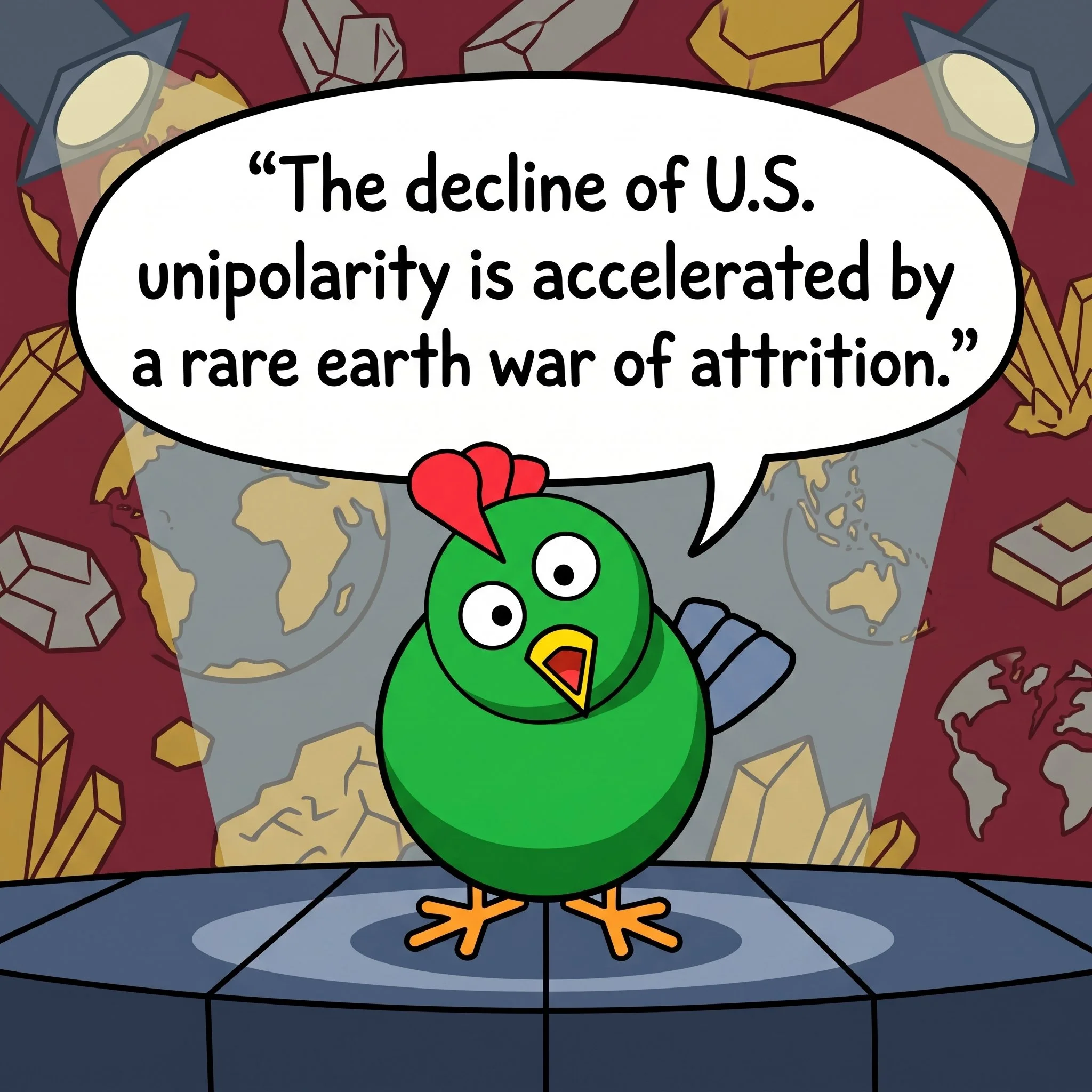
In last week’s letter, The New Frontline: Natural Resources, I discussed the strategic shifts in global resource supply and demand, particularly regarding rare earth minerals. But that was before I listened to a fascinating interview with my favorite analyst, Doomberg.
"Doomberg" is the parodic nickname of an anonymous newsletter writer—a former commodity executive who publishes financial and macroeconomic analysis on Substack. He has 384,000 readers and is ranked #3 on Substack’s Finance Bestsellers.
His name combines “Doom,” referencing his pessimistic tendencies and “berg,” a nod to Bloomberg L.P., the giant financial news and media outlet. His pen name protects his identity on the page, and when he appears on screen, he hides behind a green cartoon chicken avatar.
I pay the green chicken $400 annually for his views, gladly. It’s a bargain. Doomberg is the best analyst I know—and that’s saying something because I’m comparing him to experts and industry veterans like Lacy Hunt, David Rosenberg, Jeffrey Gundlach, Stan Druckenmiller, Mike Wilson, Felix Zulauf and all of the rest.
By the way, I maintain a “Sourcebook” resource guide featuring links and profiles for the analysts I consult regularly. If you’d like a copy, email me.
Why Doomberg Matters Right Now
Even if you don’t track financial markets closely, you may still be interested in Doomberg’s work. He covers a wide range of topics on the economy, current events and geopolitics.
I wanted to highlight his work today because his recent appearance on the Risk Takers podcast was exceptionally insightful. Doomberg dissected the unraveling global order, military miscalculations, and the structural forces reshaping the natural resource markets. He also outlined his core methodology: applying "lateral thinking" to well-curated information. Through this lens, his team builds operational "mental models"—frameworks designed to explain recent history and accurately anticipate what comes next.
Key Takeaways
The Fall of Unipolarity: We are experiencing a 1970s-style monetary pivot. As Western debt balloons and supply chain chokepoints multiply, global reserve assets are decoupling from the U.S. dollar—positioning neutral collateral like gold and decentralized digital assets at the forefront.
Industrial Reality vs. Policy: Decades of offshoring have stripped Western military planners of the capacity required to sustain prolonged conflicts or replenish critical defenses, such as air defense missiles.
China's Structural Upper Hand: By dominating rare earth mining, processing, and heavy industrial output (steel, energy, manufacturing), China holds a distinct structural advantage in modern, long-haul attrition warfare.
Geopolitical Realignment: Middle Eastern flashpoints highlight a widening gap between political ambitions and battlefield logistics, accelerating a strategic retreat of U.S. power back toward the Western Hemisphere.
The Treasury Shift: With U.S. debt exceeding $40 trillion and annual deficits near $2 trillion, foreign central banks—wary of sanctions and reserve seizures—no longer view U.S. Treasuries as risk-free "money good." Foreign central banks are actively reallocating toward physical gold.
Fiscal Dominance & Debasement: Recent interventions in foreign exchange and domestic bond markets signal an implicit drift toward yield curve control. When international buyers stop absorbing debt organically, central banks inevitably print—devaluing fiat currency relative to tangible assets.
Market-Cap Inflation: While U.S. stock indices trade near highs, much of this reflects stealth financial repression and currency dilution rather than underlying industrial power.
Implications for Investors
During historic transitions like these, investors must detach emotionally from standard Wall Street playbooks and adapt to physical reality.
Avoiding long-duration fixed income makes sense when fixed-coupon bonds paid in debased dollars carry uncompensated structural risk. Instead, real assets—physical commodities, energy producers, precious metals, and select hard assets—offer a practical hedge for preserving purchasing power over the decade ahead.
It might seem absurd to take strategic investment cues from an anonymous green chicken, but in an industry dominated by institutional narrative-spinning and outdated consensus models, unconventional wisdom is often where the real signal lives. True clarity doesn't require a traditional Wall Street suit—sometimes, it just takes an independent thinker willing to look at the cold, hard physical realities beneath the noise.
◇ ◇ ◇
Some interesting things I came across this week…
Global bond yields have surged to multi-year highs. “The global bond market is starting to look like a controlled demolition,” explains Patrick Ceresna of Big Picture Trading.
Bond Market Tests Limits of Treasury Intervention: Barry Ritholtz explains why intervention may provide short-term relief but cannot override persistent inflation, rising debt and the forces setting long-term yields.
CNBC’s Rick Santelli and Steve Liesman discuss rising bond yields and fixing the U.S. debt problem.
Economist Torsten Slok explains why higher interest rates are slowing the economy less than in past cycles.
How Treasury bond buybacks helped bitcoin surge 25%.
AI hyperscalers are spending billions on AI data centers and chips. AI prices (token costs) are falling faster than operational costs due to the rise of open-source models, signaling that the AI path to profitability is non-existant.
◇ ◇ ◇
Off the beaten path...
Sea Gypsies: The Far Side of the World: Crewed by a band of renegades, Infinity is a hand-built 120-foot boat that sails without insurance or permission on a reckless, awe-seeking voyage from New Zealand to Patagonia via Antarctica, confronting extreme weather, joining environmental activism, and pushing the limits of raw adventure.
The “fall of Rome” is a myth—the empire unraveled over a three hundred-year period that included plagues, climate shifts, hyperinflation, and military miscalculations.
Before its infamous collapse, the East India Company ruled the world as a ruthless machine, conquering empires, building private armies, and rewriting global trade through the spice trade.
◇ ◇ ◇
When you're ready, here's how I can help:
Review your investments. Your "buy-and-hope" portfolio presents a serious risk to your retirement plan. I'll review your holdings one-by-one and share ideas for how to de-risk.
Free portfolio analysis. Get a comprehensive portfolio analysis with Portfolio Visualizer, an institutional-grade tool that measures portfolio risk, volatility and diversification gaps.
Free Retirement Planning Tool. I've partnered with ProjectionLab, a simple but detailed financial planning tool that will reduce anxiety around your finances.
Learn how we invest for clients. Every quarter we provide clients with a detailed Investment Outlook that explains exactly how they're invested and why.
Thanks for reading. I'd love to hear from you!
I founded Alpha Rock to provide investors the highest level of personal service. Discover the benefits of working with a solo advisor and contact me directly with your thoughts, questions and feedback.

IMPORTANT DISCLOSURE INFORMATION
This commentary reflects the personal opinions, viewpoints and analyses of the Alpha Rock Investments, LLC employees providing such comments, and should not be regarded as a description of advisory services provided by Alpha Rock Investments, LLC or performance returns of any Alpha Rock Investments, LLC client. The views reflected in the commentary are subject to change at any time without notice. Nothing in this commentary constitutes investment advice, performance data or any recommendation that any particular security, portfolio of securities, transaction or investment strategy is suitable for any specific person. Any mention of a particular security and related performance data is not a recommendation to buy or sell that security. Alpha Rock Investments, LLC manages its clients’ accounts using a variety of investment techniques and strategies, which are not necessarily discussed in the commentary. Investments in securities involve the risk of loss. Past performance is no guarantee of future results.
The S&P 500 Index or the Standard & Poor's 500 Index is a market-capitalization-weighted index of the 500 largest U.S. publicly traded companies. The S&P 500 is a float-weighted index, meaning company market capitalizations are adjusted by the number of shares available for public trading. Note: Investors cannot invest directly in an index. These unmanaged indices do not reflect management fees and transaction costs that are associated with most investments.
Alpha Rock Investments, LLC provides links for your convenience to websites produced by other providers of industry related material. Accessing websites through links directs you away from our website. Alpha Rock Investments, LLC is not responsible for errors or omissions in the material on third party websites, and does not necessarily approve of or endorse the information provided. Users who gain access to third party websites may be subject to the copyright and other restrictions on use imposed by those providers and assume responsibility and risk from use of those websites.