The Fallacy of Time Diversification
The following is an exerpt from my upcomming book: Wall Street Snake Oil: The Myth of Passive Investing.
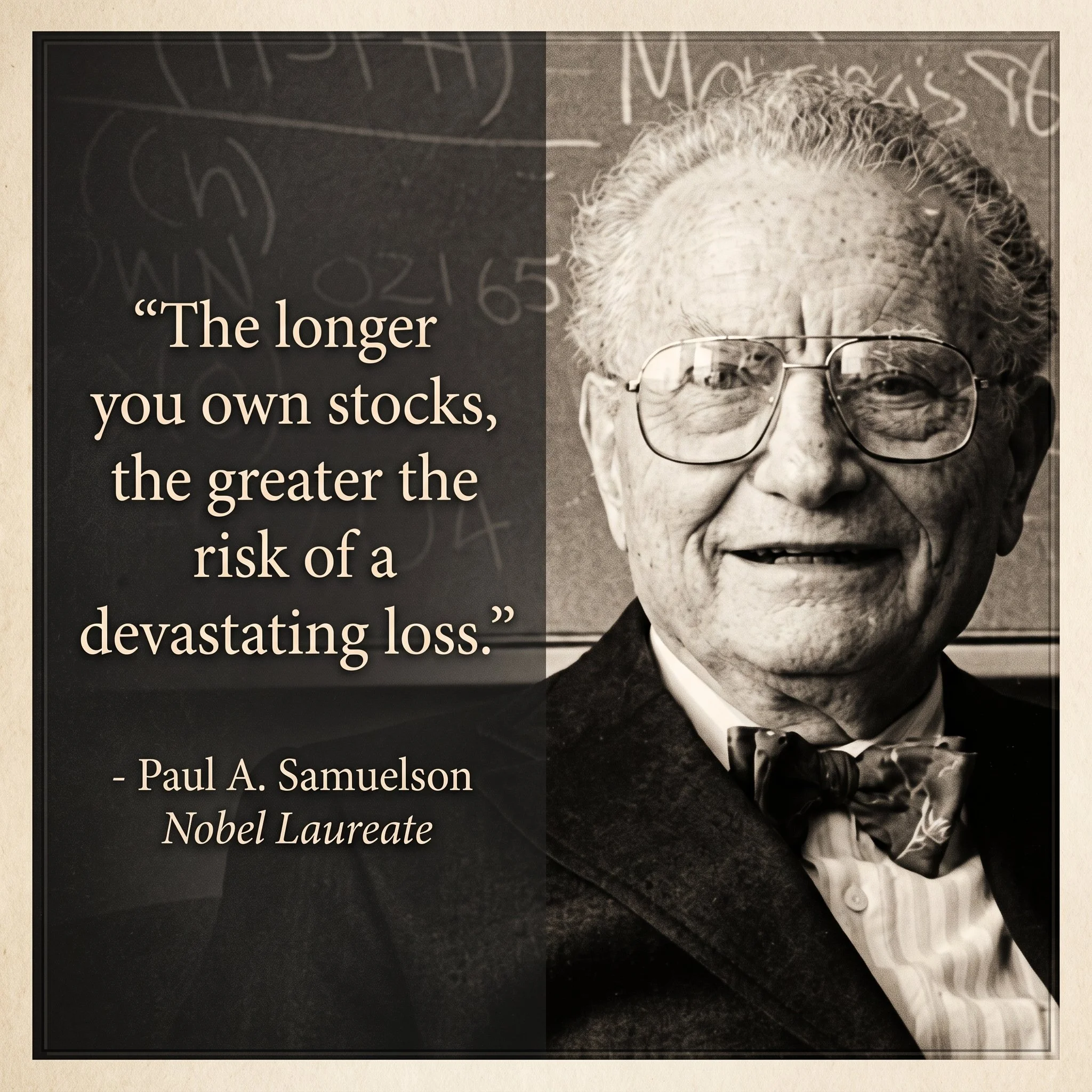
Paul Samuelson is one of the most influential economists in history. He won the Nobel Prize in Economics in 1970 and aggressively combated the traditional Wall Street dogma that stocks become safer the longer you hold them.
In his 1963 paper, “Risk and Uncertainty: A Fallacy of Large Numbers,” he mathematically dismantled this concept, known today as time diversification. Most investors and financial professionals confuse two very different metrics: average annual returns and terminal wealth.
The Illusion: It is true that as time passes, the probability of underperforming cash or experiencing a negative average annualized return shrinks.
The Reality: You do not buy groceries with percentages; you buy them with absolute dollars. Over a 30-year horizon, the variance (uncertainty) of your final net worth grows exponentially.
While the odds of losing money drop, the magnitude of a potential loss in the worst-case scenario increases severely. A single market crash right before you retire can wipe out decades of accumulated compounding gains—this is the "devastating loss" Samuelson warns against.
Modern portfolio theory depends primarily on the false premise of time diversification—the idea that the longer you own stocks, the safer your portfolio. Wall Street has built an entire industry around this fallacy and it’s the reason that every target-date 2060 fund holds more stocks than every target-date 2040 fund.
Every major stock market in the world has declined by 70% or more at least once and have had multiple declines of 50% or more. The risk of catastrophic loss does not decrease with time; it increases. Common sense confirms this. Think about driving your car. Does the risk of having an accident increase or decrease with time behind the wheel?
Wall Street does not care about your true risk tolerance. If they did, your advisor would explain that, over time, the risk of your portfolio being impacted by a severe market crash increases. Instead, he tells you it decreases, because that’s what he’s been taught.
You understand intuitively that active portfolio management can reduce risk by tactically shifting portfolio holdings. Using the car analogy, you know that the less you drive, the lower the probability that you will crash. During periods when stock prices are overvalued, it makes sense to actively shift allocations to less risky investments. For investors who value risk management, active management and diversification to uncorrelated asset classes offer benefits passive strategies can’t provide.
◇ ◇ ◇
Some interesting things I came across this week…
Nvidia CEO Jensen Huang declares 'AGI has arrived.'
Tracking Trillions: The Assumptions Shaping the Scale of the AI Build-Out
Silicon Valley's AI Cult: How doom philosophy shaped OpenAI and Anthropic—and why superintelligence fears reflect profit and ideology, not technical reality.
David Rosenberg shares his views on the U.S. economy and AI bubble risks that could ripple.
Net interest and entitlement expenses account for 98% of tax receipts
“At turning points in the economy, the outcomes are determined by the institutions, fiscal constraints, failures and demographic forces that models struggle to capture” …And other lessons from Charles Goodhart
◇ ◇ ◇
Off the beaten path...
Mapped: The Most Expensive U.S. States for Utilities
Federal Agents Are Secretly Monitoring Americans’ Financial Transactions, Facilitating Arrests
What Really Happened To Philip Seymour Hoffman?
Philadelpha Eagles Players Meet the 12-Year-Old Viral Bird Calling Kid
◇ ◇ ◇
When you're ready, here's how I can help:
Review your investments. Your "buy-and-hope" portfolio presents a serious risk to your retirement plan. I'll review your holdings one-by-one and share ideas for how to de-risk.
Free portfolio analysis. Get a comprehensive portfolio analysis with Portfolio Visualizer, an institutional-grade tool that measures portfolio risk, volatility and diversification gaps.
Free Retirement Planning Tool. I've partnered with ProjectionLab, a simple but detailed financial planning tool that will reduce anxiety around your finances.
Learn how we invest for clients. Every quarter we provide clients with a detailed Investment Outlook that explains exactly how they're invested and why.
Thanks for reading. I'd love to hear from you!
I founded Alpha Rock to provide investors the highest level of personal service. Discover the benefits of working with a solo advisor and contact me directly with your thoughts, questions and feedback.

IMPORTANT DISCLOSURE INFORMATION
This commentary reflects the personal opinions, viewpoints and analyses of the Alpha Rock Investments, LLC employees providing such comments, and should not be regarded as a description of advisory services provided by Alpha Rock Investments, LLC or performance returns of any Alpha Rock Investments, LLC client. The views reflected in the commentary are subject to change at any time without notice. Nothing in this commentary constitutes investment advice, performance data or any recommendation that any particular security, portfolio of securities, transaction or investment strategy is suitable for any specific person. Any mention of a particular security and related performance data is not a recommendation to buy or sell that security. Alpha Rock Investments, LLC manages its clients’ accounts using a variety of investment techniques and strategies, which are not necessarily discussed in the commentary. Investments in securities involve the risk of loss. Past performance is no guarantee of future results.
The S&P 500 Index or the Standard & Poor's 500 Index is a market-capitalization-weighted index of the 500 largest U.S. publicly traded companies. The S&P 500 is a float-weighted index, meaning company market capitalizations are adjusted by the number of shares available for public trading. Note: Investors cannot invest directly in an index. These unmanaged indices do not reflect management fees and transaction costs that are associated with most investments.
Alpha Rock Investments, LLC provides links for your convenience to websites produced by other providers of industry related material. Accessing websites through links directs you away from our website. Alpha Rock Investments, LLC is not responsible for errors or omissions in the material on third party websites, and does not necessarily approve of or endorse the information provided. Users who gain access to third party websites may be subject to the copyright and other restrictions on use imposed by those providers and assume responsibility and risk from use of those websites.