The Enron Echo: Data Centers as Subprime Debt
The trillion-dollar AI infrastructure boom is hurtling toward a brick wall, and global financial markets are in the passenger seat.
Paul Kedrosky, a venture capitalist and advisor to several hedge funds sat down with Dick Costolo, former CEO of Twitter to unpack the systemic risks quietly brewing behind the massive AI data center spending boom: Big Tech's AI Spending Has Gone Full Enron.
“Big Tech” includes most of the Mag 7: Microsoft (MSFT), NVIDIA (NVDA) Alphabet (GOOGL), Amazon (AMZN) and Meta, plus Oracle (ORCL).
Kedrosky and Costolo break down how Big Tech's insatiable capital expenditure mirrors historical financial bubbles—specifically the 19th-century railroad mania—with a few modern structural twists that are amplifying the danger for asset markets more broadly.
Many have compared the AI infrastructure boom to the dot-com fiber bust, but the underlying financial dynamics are dangerously different, with much broader implications.
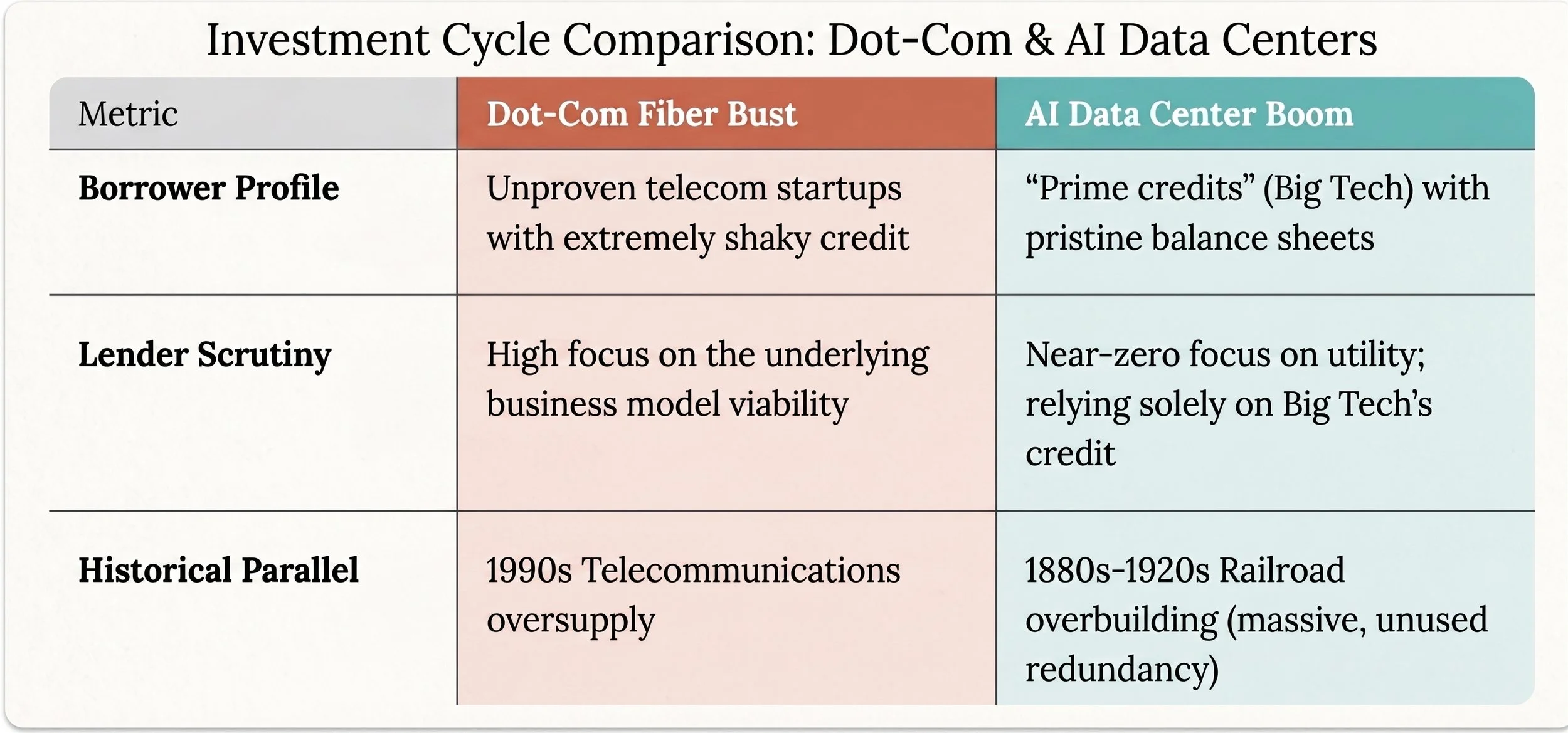
Lenders are funding the data center boom based solely on Big Tech's flawless credit scores rather than the actual viability of the AI projects, the market is accelerating blind.
Guaranteed Overbuilding: Without lenders scrutinizing the underlying business models, capital is flowing endlessly into construction. Just like the 19th-century railroad boom, this lack of friction virtually guarantees a massive oversupply of data centers that token demand simply won't support.
Hidden Financial Rot: To protect their earnings per share from this massive capital expenditure, Big Tech is shoving this debt into opaque, off-balance-sheet Special Purpose Vehicles (SPVs). With the SEC allowing this debt to be syndicated, the risk is being sliced and sold off out of sight, heavily echoing the 2008 mortgage crisis.
Systemic Contagion: Because the borrowers are trillion-dollar titans rather than scrappy 90s telecom startups, the sheer scale of their borrowing is siphoning liquidity out of the broader financial system. It is actively pulling capital away from other equities and pulling retail yield-chasers out of US Treasuries.
The "Pickleball Court" Pivot: When the price of AI tokens inevitably collapses—driven down by open-source competition and plateauing capabilities—these data centers will not generate the cash flow needed to service their debt. Since the lenders never verified the business models, they will be left holding the bag on the world's most expensive empty warehouses. Pickleball courts?
The Enron Echo: Off-Balance Sheet Shenanigans
Big Tech companies are heavily diluting their cash flows through massive stock-based compensation and mandatory stock buybacks, forcing them to push capital-intensive data center costs off their immediate balance sheets. They are quietly funneling this debt into obscurely named Special Purpose Vehicles (SPVs) partnered with loosely regulated shadow banks. A recent SEC "no-action" letter compounds this risk by allowing data center debt to be syndicated exactly like pre-2008 mortgage-backed securities, supercharging blind construction and guaranteeing immense oversupply.
Systemic Contagion
Trillions of dollars in infrastructure financing must be pulled from somewhere else in the financial system. Meanwhile, bond investors are pivoting away from US Treasuries to chase higher yields on Big Tech data center debt, disrupting the sovereign debt market and forcing the US Treasury into awkward defensive maneuvers.
The unprecedented influx of capital into AI infrastructure is driven entirely by Big Tech's pristine credit ratings and is divorced from the fundamental economics of crashing token prices. As model progress slows and off-balance sheet debt syndication ramps up, the hidden financial architecture supporting this technological boom is growing dangerously fragile.
◇ ◇ ◇
Some interesting things I came across this week…
The Rally Is Broadening. The Earnings Growth Isn't. Schwab’s Liz Ann Sonders on Which Breaks First.
Uranium does not trade on a central exchange where physical supply clears each day—spot prices only tell half the story.
Thomson Reuters built an LLM that’s competitive with the world’s strongest frontier AI models—at a fraction of the cost.
News reports of a “swarm of AI agents that escaped OpenAI’s test environments” sound scary. The great Cal Newport explains the truth about OpenAI’s “Secret AI Civilizations”
Meta settles social media addiction case with California, other states for $16.7 billion
Expectations of future earnings growth matter a great deal to stock valuations, but there is little to no evidence of persistence beyond chance.
◇ ◇ ◇
Off the beaten path...
Eighty-six percent of U.S. investors believe lawmakers trade inside information, while 90% don't trust Congress to police its own stock trading.
Magnus Carlsen showed up late to the 2022 World Blitz Chess Championship with just 30 seconds remaining on his game clock.
B. B. King performs “The Thrill Is Gone,” live at Montreux Jazz Festival in 1993.
◇ ◇ ◇
When you're ready, here's how I can help:
Review your investments. Your "buy-and-hope" portfolio presents a serious risk to your retirement plan. I'll review your holdings one-by-one and share ideas for how to de-risk.
Free portfolio analysis. Get a comprehensive portfolio analysis with Portfolio Visualizer, an institutional-grade tool that measures portfolio risk, volatility and diversification gaps.
Free Retirement Planning Tool. I've partnered with ProjectionLab, a simple but detailed financial planning tool that will reduce anxiety around your finances.
Learn how we invest for clients. Every quarter we provide clients with a detailed Investment Outlook that explains exactly how they're invested and why.
Thanks for reading. I'd love to hear from you!
I founded Alpha Rock to provide investors the highest level of personal service. Discover the benefits of working with a solo advisor and contact me directly with your thoughts, questions and feedback.

IMPORTANT DISCLOSURE INFORMATION
This commentary reflects the personal opinions, viewpoints and analyses of the Alpha Rock Investments, LLC employees providing such comments, and should not be regarded as a description of advisory services provided by Alpha Rock Investments, LLC or performance returns of any Alpha Rock Investments, LLC client. The views reflected in the commentary are subject to change at any time without notice. Nothing in this commentary constitutes investment advice, performance data or any recommendation that any particular security, portfolio of securities, transaction or investment strategy is suitable for any specific person. Any mention of a particular security and related performance data is not a recommendation to buy or sell that security. Alpha Rock Investments, LLC manages its clients’ accounts using a variety of investment techniques and strategies, which are not necessarily discussed in the commentary. Investments in securities involve the risk of loss. Past performance is no guarantee of future results.
The S&P 500 Index or the Standard & Poor's 500 Index is a market-capitalization-weighted index of the 500 largest U.S. publicly traded companies. The S&P 500 is a float-weighted index, meaning company market capitalizations are adjusted by the number of shares available for public trading. Note: Investors cannot invest directly in an index. These unmanaged indices do not reflect management fees and transaction costs that are associated with most investments.
Alpha Rock Investments, LLC provides links for your convenience to websites produced by other providers of industry related material. Accessing websites through links directs you away from our website. Alpha Rock Investments, LLC is not responsible for errors or omissions in the material on third party websites, and does not necessarily approve of or endorse the information provided. Users who gain access to third party websites may be subject to the copyright and other restrictions on use imposed by those providers and assume responsibility and risk from use of those websites.