Q4 Investment Outlook: The Gravity of Market History
On November 22, 1999, while the dot-com boom was in full swing, FORTUNE Magazine published an account of four intimate talks given by legendary investor Warren Buffett—a masterclass in market history, patience, and investment wisdom.
Between 1964 and 1981, U.S. gross domestic product grew by 370%, a period of strong economic growth. But during that 17-year period, the stock market was stagnant—the Dow Jones Industrial Average started at 874 and finished at 875. For nearly two decades, American business boomed, but stock investors stood still.
Then, from 1981 to 1998, after Paul Volcker broke the back of inflation, GDP grew at a slower pace, but the DJIA skyrocketed from 875 to over 9,100—a historic rally that led investors to expect double-digit annual returns for years to come.
Speaking to investors in the second half of 1999, Buffett explained:
“To understand what happened, we need first to look at one of the two important variables that affect investment results: interest rates. These act on financial valuations the way gravity acts on matter: The higher the rate, the greater the downward pull. That's because the rates of return that investors need from any kind of investment are directly tied to the risk-free rate that they can earn from government securities. So if the government rate rises, the prices of all other investments must adjust downward, to a level that brings their expected rates of return into line. Conversely, if government interest rates fall, the move pushes the prices of all other investments upward. The basic proposition is this: What an investor should pay today for a dollar to be received tomorrow can only be determined by first looking at the risk-free interest rate.”
During the period from 1964 to 1981, the gravitational pull of interest rates, which rose from just over 4% to more than 15%, “had a huge depressing effect on the value of all investments,” said Buffett. Then, from 1981 to 1998, interest rates tumbled toward 5%, driving asset prices higher. Declining interest rates, he explained, are one of “three things that might allow investors to realize significant profits in the market going forward.”
In 1998, the yield on 10-year U.S. government bonds fell to 4.4% while total federal debt was $5.7 trillion. In the decade that followed, interest rates continued to drop as the Federal Reserve implemented ZIRP (Zero Interest Rate Policy) which kept interbank lending rates near zero and borrowing costs low for businesses and consumers. Today, $40.3 trillion in outstanding government debt, rising interest rates and higher borrowing costs are forming a headwind for the economy.
In 1999, Buffett suggested a second (unlikely) thing that Buffett said could drive stock prices higher: “Corporate profitability in relation to GDP must rise.”
The Limits of Corporate Profitability
By the late 90s the combined market value of the FORTUNE 500 companies was $9.9 trillion and after-tax profits were $334 billion or just under 6% of GDP, which means investors were paying a multiple of 29.6 times annual profits to own shares of America’s largest companies. As of June 2025, the combined market value of the FORTUNE 500 companies was $46 trillion and after-tax profits were $1.9 trillion or about 6.2% of GDP—a multiple of 24.6.
According to the Bureau of Economic Analysis, which tracks after-tax profits for all U.S. companies, the long term average is 7.4% of GDP. As of September 30, 2026, corporate profits measured were 13.1% of GDP, nearly twice the long-term average.
This is where gravity comes in, explained Buffett: “When you begin to expect the growth of a component factor to forever outpace that of the aggregate, you get into certain mathematical problems. In my opinion, you have to be wildly optimistic to believe that corporate profits as a percent of GDP can, for any sustained period, hold much above 6%. Beyond that, you need to remember that future returns are always affected by current valuations and give some thought to what you're getting for your money in the stock market right now.”
The Gravity of Today's Valuations
Before we get to the Wright Brothers and Mr. Buffett’s third possible source of future profits for investors in 1999, we should look at current valuations and, well… give some thought to what investors are getting for their money today.
Robert Shiller, the Nobel laureate who, in March 2000, claimed that the U.S. stock market had become a bubble, created an index stock market analysts use to measure the value investors are getting in the stock market: The Cyclically Adjusted Price-to-Earnings (CAPE) Ratio (or Shiller PE Ratio) divides the current market price of the S&P 500 by the average inflation-adjusted earnings over the past 10 years. Measuring returns over a long period of time removes the noise and provides a clear picture of long term valuation.
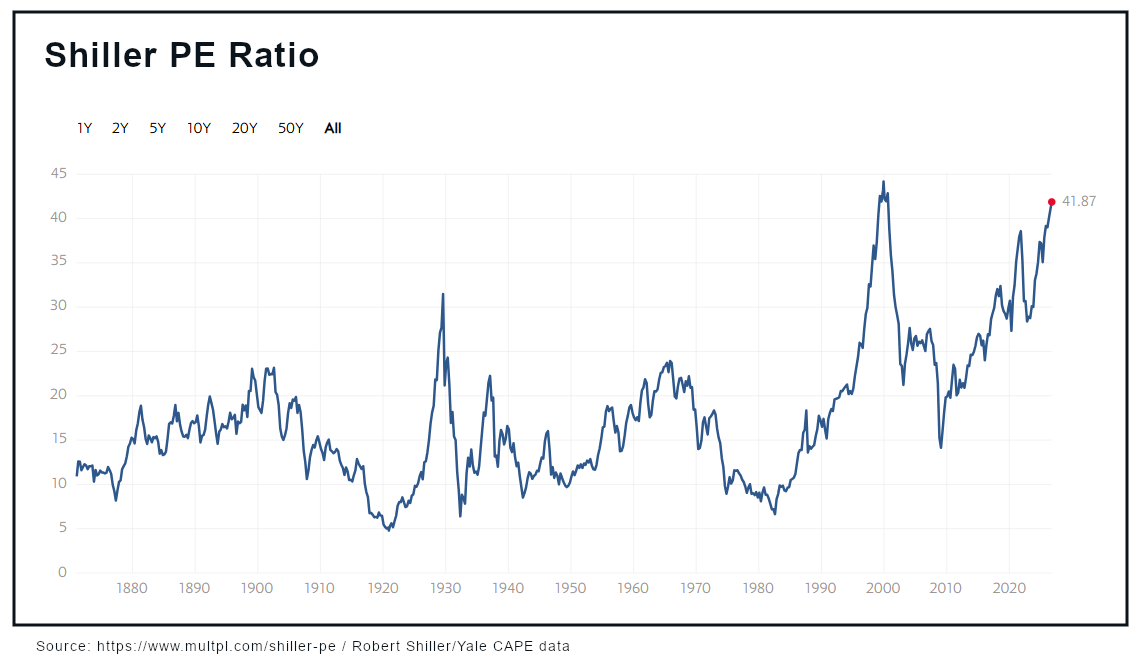
The average CAPE Ratio, from 1871-2026 is 17.4. A high CAPE Ratio indicates that stocks are generally expensive relative to corporate earnings and tends to correlate with lower expected annualized returns over the subsequent 10 to 20 years. A low CAPE Ratio suggests stocks are generally cheap relative to company earnings and investors may expect higher future returns.
The CAPE Ratio is not a forecast. It doesn’t tell us what stocks will do next month or next year, but it does provide a useful context to consider when constructing an investment portfolio.
Investors tend to make one of two mistakes when thinking about an expensive stock market. They either dismiss valuation completely because it didn’t predict the recent stock market run-up or they panic and feel like they should sell everything.
Valuation is just context—it describes the environment. High valuations are like gravity. A high CAPE Ratio may not stop the market from climbing higher, it just tends to make the climbing more difficult and the risk of falling greater.
Each dot on the scatter chart below represents the annualized subsequent 10-year real (inflation-adjusted) returns from its starting CAPE Ratio. Dots on the right side of the chart had higher starting CAPE Ratios (i.e. higher valuations) and dots closer to the bottom of the chart had lower 10-year forward annualized returns.
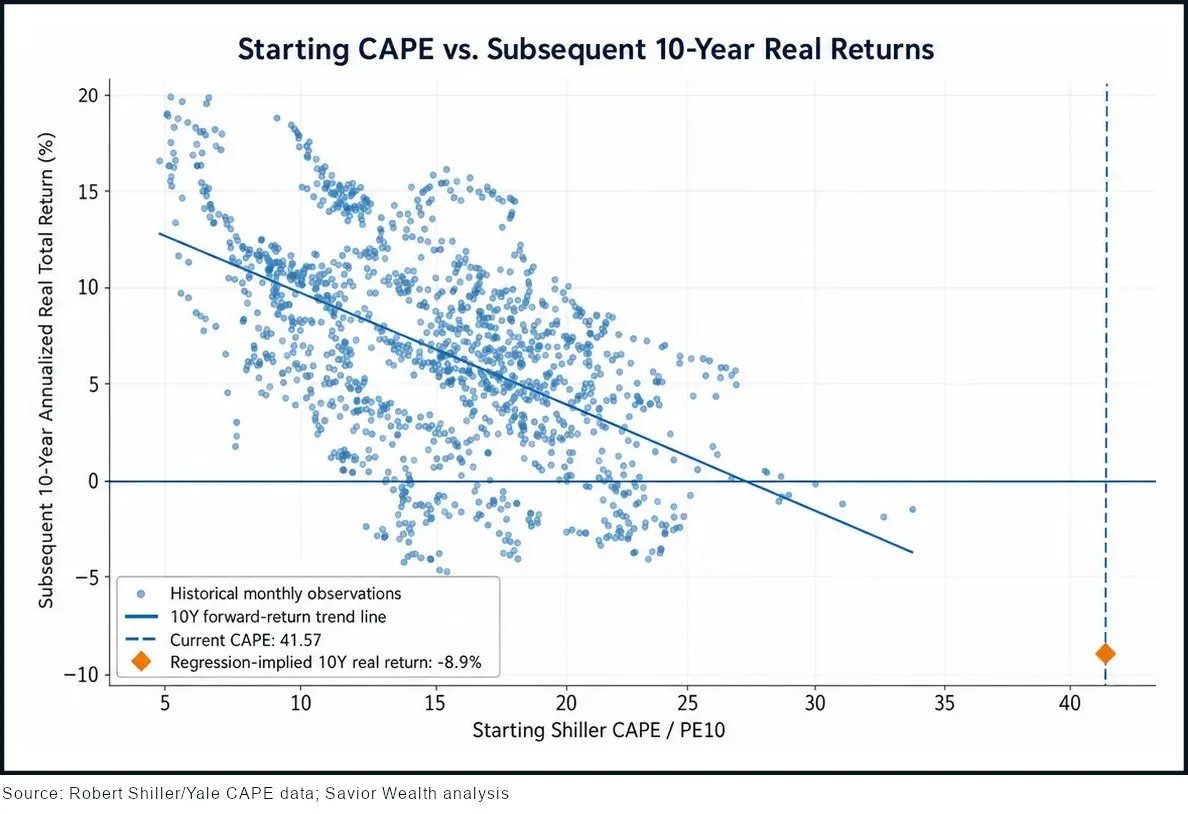
The downward slope is impossible to ignore: a low CAPE Ratios are strongly correlated with periods of high future returns and a high CAPE Ratios are strongly correlated with periods of low future returns. In fact, there has never been a 10-year period of positive real returns from a CAPE Ratio higher than 30. Today’s CAPE ratio sits at 41.9, nearly an all-time high. The gravity in today’s investment environment is heavy. Investors who want to keep climbing are taking significant risk.
Probabilities suggest that from where stock valuations are today, the most likely after- inflation 10-year future annualized return is -8.9%. Investors who hold stocks today may be rewarded, they may fall or they may muddle through, but we can be sure they’re gambling.
Enough depressing data, let’s get back to Warren Buffett and the Wright Brothers’ first flight to see if we can learn something about the first LLMs.
Technological Revolutions Don't Guarantee Profits for Investors
Here’s what Mr. Buffett had to say about the first flight and one of the greatest technological advances of all-time: “I like to think that if I'd been at Kitty Hawk in 1903 when Orville Wright took off, I would have been farsighted enough, and public-spirited enough—I owed this to future capitalists—to shoot him down. I mean, Karl Marx couldn't have done as much damage to capitalists as Orville did.”
From the dawn of aviation until 1992 hundreds of airline manufacturers existed and, combined, generated zero profits. Between 1980 and 2000, 129 airlines filed for bankruptcy, and the survivors operate as a commodity business while the largest manufacturer, Boeing, is heavily subsidized.
Canals, railroads, cars, radios and televisions were all transformational and changed life as we know it, but failed to reward investors. Seventy car and truck manufacturers operated in the 19th century and the industry has grown exponentially, but trying to pick the winners has been a loser’s game. And for the lucky investors who did, it’s been a volatile ride with modest returns.
A technological revolution doesn't guarantee profits for investors. “The key to investing is not assessing how much an industry is going to affect society, or how much it will grow, but rather determining the competitive advantage of any given company and, above all, the durability of that advantage. The products or services that have wide, sustainable moats around them are the ones that deliver rewards to investors,” Buffett explained.
Positioning for the Current Environment
Navigating today’s investment environment—an atmosphere heavy with gravity and the promise of super-human intelligence from AI—requires an investment discipline rooted in patience, selectivity, and capital preservation.
Recognizing that large-cap U.S. equities are now bearing the brunt of these stretched valuations, we are avoiding the lure of large-cap stocks trading at historic heights. Instead, we are focused on managing risk and finding opportunities in neglected corners of the global market.
An overview of our two investment strategies, Alpha Rock Growth and Alpha Rock Income, along with a detialed explanation of how we’re investing for clients today, is available for download.
◇ ◇ ◇
Some interesting things I came across this week…
The S&P 500 Hit Another Record High Last Week Powered by Tech—and Not Much Else (The Wall Street Journal)
Bill Gross: Don’t own bonds and be cautious with stocks (Financial Times)
No Signs of AI in the Productivity Data (The Daily Spark)
Silicon Valley’s Mainstream Ideology is Fringe, Extreme and Bizarre (Cal Newport)
◇ ◇ ◇
Off the beaten path...
Jon Stewart interviewed Jacob Coxon, who recently resigned from Anthropic over growing concern around the reckless race toward uncontrollable self-improving superintelligence (The Daily Show)
Anthropic co-founder used stuffed animals as a "personal advisory council" (Yahoo!)
Why the Manufacturing and the Regulatory Guidance of mRNA Vaccines Matters (Brownstone Institute)
CIA Officer Pleads Quilty to Stealing $200 Million from U.S. Government (Iowa Local 5 News)
◇ ◇ ◇
When you're ready, here's how I can help:
Review your investments. Your "buy-and-hope" portfolio presents a serious risk to your retirement plan. I'll review your holdings one-by-one and share ideas for how to de-risk.
Free portfolio analysis. Get a comprehensive portfolio analysis with Portfolio Visualizer, an institutional-grade tool that measures portfolio risk, volatility and diversification gaps.
Free Retirement Planning Tool. I've partnered with ProjectionLab, a simple but detailed financial planning tool that will reduce anxiety around your finances.
Learn how we invest for clients. Every quarter we provide clients with a detailed Investment Outlook that explains exactly how they're invested and why.
Thanks for reading. I'd love to hear from you!
I founded Alpha Rock to provide investors the highest level of personal service. Discover the benefits of working with a solo advisor and contact me directly with your thoughts, questions and feedback.

IMPORTANT DISCLOSURE INFORMATION
This commentary reflects the personal opinions, viewpoints and analyses of the Alpha Rock Investments, LLC employees providing such comments, and should not be regarded as a description of advisory services provided by Alpha Rock Investments, LLC or performance returns of any Alpha Rock Investments, LLC client. The views reflected in the commentary are subject to change at any time without notice. Nothing in this commentary constitutes investment advice, performance data or any recommendation that any particular security, portfolio of securities, transaction or investment strategy is suitable for any specific person. Any mention of a particular security and related performance data is not a recommendation to buy or sell that security. Alpha Rock Investments, LLC manages its clients’ accounts using a variety of investment techniques and strategies, which are not necessarily discussed in the commentary. Investments in securities involve the risk of loss. Past performance is no guarantee of future results.
The S&P 500 Index or the Standard & Poor's 500 Index is a market-capitalization-weighted index of the 500 largest U.S. publicly traded companies. The S&P 500 is a float-weighted index, meaning company market capitalizations are adjusted by the number of shares available for public trading. Note: Investors cannot invest directly in an index. These unmanaged indices do not reflect management fees and transaction costs that are associated with most investments.
Alpha Rock Investments, LLC provides links for your convenience to websites produced by other providers of industry related material. Accessing websites through links directs you away from our website. Alpha Rock Investments, LLC is not responsible for errors or omissions in the material on third party websites, and does not necessarily approve of or endorse the information provided. Users who gain access to third party websites may be subject to the copyright and other restrictions on use imposed by those providers and assume responsibility and risk from use of those websites.