Hidden Risks Lurking in Traditional Bond Portfolios
Conventional portfolios rely heavily on broadly diversified bond funds such as the iShares Core U.S. Aggregate Bond ETF (ticker AGG) and the Vanguard Total Bond Market ETF (ticker BND), both benchmarked to the cap-weighted Bloomberg U.S. Aggregate Bond Index. Cap-weighted (or capitalization-weighted) means that the index/fund ranks issuers by the total value of their outstanding debt, giving the largest borrowers the greatest influence on performance.
Traditional portfolios, which passively hold a mix of stocks and bonds, depend heavily on the broader bond market to generate interest without taking on too much risk, but at the end of a massive global debt super-cycle, the debt markets are behaving poorly and the risks are being largely ignored by investors and advisors alike.
These massive ETFs, which combined hold over $500 billion of investor assets, are facing bond market conditions never seen before. Both AGG and BND have provided a negative total return over the last 5 years and are barely positive over the last 10 years. Over the first three quarters of 2026, both funds and their benchmark are down over 2.6%.
The Hidden Risks
The Bloomberg U.S. Aggregate Bond Index and the funds that track it were pretty well balanced 20 years ago, with about 40% to 50% of the underlying investments backed by U.S. government debt and the rest a mix of corporate bonds. But since the 2008 Great Financial Crisis, U.S. government debt has ballooned, and because the cap-weighted index is designed to shift more assets to the biggest borrowers, the percentage of government-backed debt has expanded to 70% of the allocation.
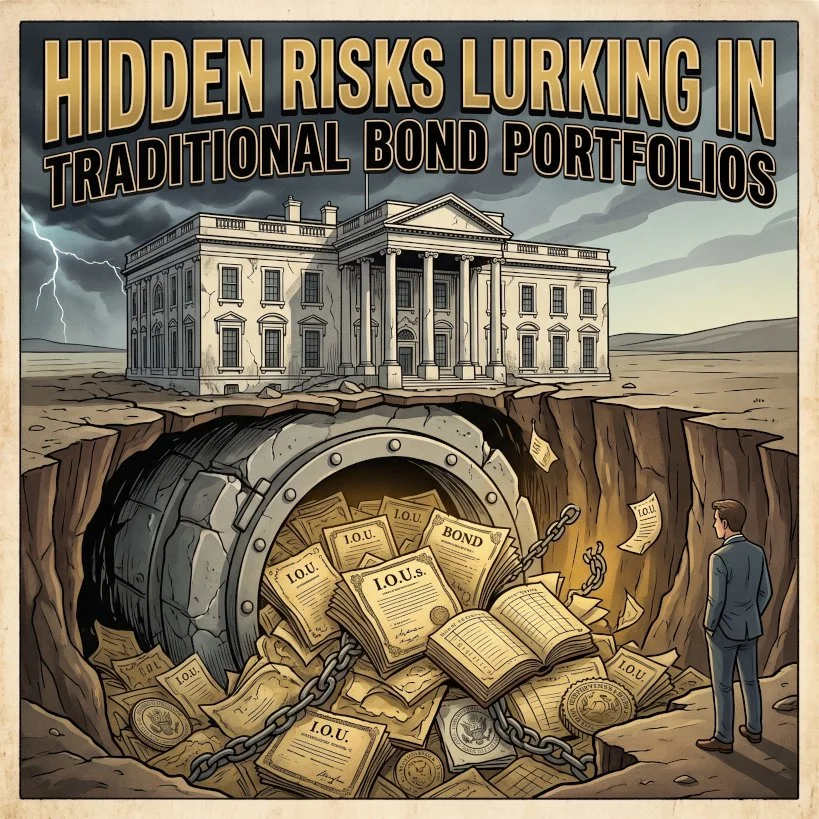
This isn't a minor tweak; it fundamentally changes what investors in traditional bond funds actually own. By holding these traditional funds, investors are now heavily tied to the U.S. government's horrific fiscal condition.
The Bloomberg Aggregate Bond Index was designed as a measuring stick to track the overall bond market—not as a blueprint for your personal portfolio. But many investors and advisors are still using funds like BND and AGG as a shortcut to get bond market exposure. In a healthy market, shortcuts don’t get exposed, but in the bond market we have today, portfolios blindly allocated to the total bond market on a cap-weighted basis are paying the price for being dangerously over-allocated to what has become the most risky part of the bond market: long-term U.S. government bonds.
How to Fix the Imbalance
Stop taking shortcuts with your portfolio. Passively owning index funds that track the broad stock and bond market may have worked in the recent past, but ultimately they’re just blind bets that assume that what has happened in the past is going to happen again in the future. The market conditions we now face are not like the past and your portfolio should reflect that.
At Alpha Rock, we’re avoiding both long-term government bonds and long-term corporate bonds entirely. Short-term bonds are paying attractive yields today with less risk. Emerging market bonds and floating-rate debt (bonds whose interest payments increase when interest rates rise) are also more attractive than traditional bond allocations in current market conditions.
Next week, we will publish our 4th Quarter Investment Outlook, which will go into more detail on how we’re investing in today’s uncertain and risky times. Clients will receive the Outlook by email and it will be made available to the public here on our website. If you’re not a client, email service@alpharockinvestments.com and we’ll deliver the Outlook directly to your inbox.
◇ ◇ ◇
Some interesting things I came across this week…
What’s going on in the bond market? (Apollo)
Trump says inflation could rebalance the $40 trillion U.S. national debt (Fortune)
Why are European countries moving their gold out of North America? (BBC)
Wealthy Americans are tapping into their investment accounts to spend (Financial Advisor)
Robots are Not Coming for Your Job (The Daily Spark)
Why the China Threat Is Overblown (Hidden Forces)
◇ ◇ ◇
Off the beaten path...
Investigating the Online Scam Epidemic (FRONTLINE/AP)
Another OpenAI Model Goes Rogue; Leaks User Images to Web (ZeroHedge)
Will Muse Curb Consumer Spending? (The Daily Spark)
Revenge Is a Central Pillar of Iranian Foreign Policy (Wall Street Journal)
◇ ◇ ◇
When you're ready, here's how I can help:
Review your investments. Your "buy-and-hope" portfolio presents a serious risk to your retirement plan. I'll review your holdings one-by-one and share ideas for how to de-risk.
Free portfolio analysis. Get a comprehensive portfolio analysis with Portfolio Visualizer, an institutional-grade tool that measures portfolio risk, volatility and diversification gaps.
Free Retirement Planning Tool. I've partnered with ProjectionLab, a simple but detailed financial planning tool that will reduce anxiety around your finances.
Learn how we invest for clients. Every quarter we provide clients with a detailed Investment Outlook that explains exactly how they're invested and why.
Thanks for reading. I'd love to hear from you!
I founded Alpha Rock to provide investors the highest level of personal service. Discover the benefits of working with a solo advisor and contact me directly with your thoughts, questions and feedback.

IMPORTANT DISCLOSURE INFORMATION
This commentary reflects the personal opinions, viewpoints and analyses of the Alpha Rock Investments, LLC employees providing such comments, and should not be regarded as a description of advisory services provided by Alpha Rock Investments, LLC or performance returns of any Alpha Rock Investments, LLC client. The views reflected in the commentary are subject to change at any time without notice. Nothing in this commentary constitutes investment advice, performance data or any recommendation that any particular security, portfolio of securities, transaction or investment strategy is suitable for any specific person. Any mention of a particular security and related performance data is not a recommendation to buy or sell that security. Alpha Rock Investments, LLC manages its clients’ accounts using a variety of investment techniques and strategies, which are not necessarily discussed in the commentary. Investments in securities involve the risk of loss. Past performance is no guarantee of future results.
The S&P 500 Index or the Standard & Poor's 500 Index is a market-capitalization-weighted index of the 500 largest U.S. publicly traded companies. The S&P 500 is a float-weighted index, meaning company market capitalizations are adjusted by the number of shares available for public trading. Note: Investors cannot invest directly in an index. These unmanaged indices do not reflect management fees and transaction costs that are associated with most investments.
Alpha Rock Investments, LLC provides links for your convenience to websites produced by other providers of industry related material. Accessing websites through links directs you away from our website. Alpha Rock Investments, LLC is not responsible for errors or omissions in the material on third party websites, and does not necessarily approve of or endorse the information provided. Users who gain access to third party websites may be subject to the copyright and other restrictions on use imposed by those providers and assume responsibility and risk from use of those websites.