New Red Flag for Stocks: AI Debt
Stock investors still believe the AI buildout is a growth story with no end in sight, but the bond market is flashing a major warning sign with AI’s massive, debt-fueled spending spree.
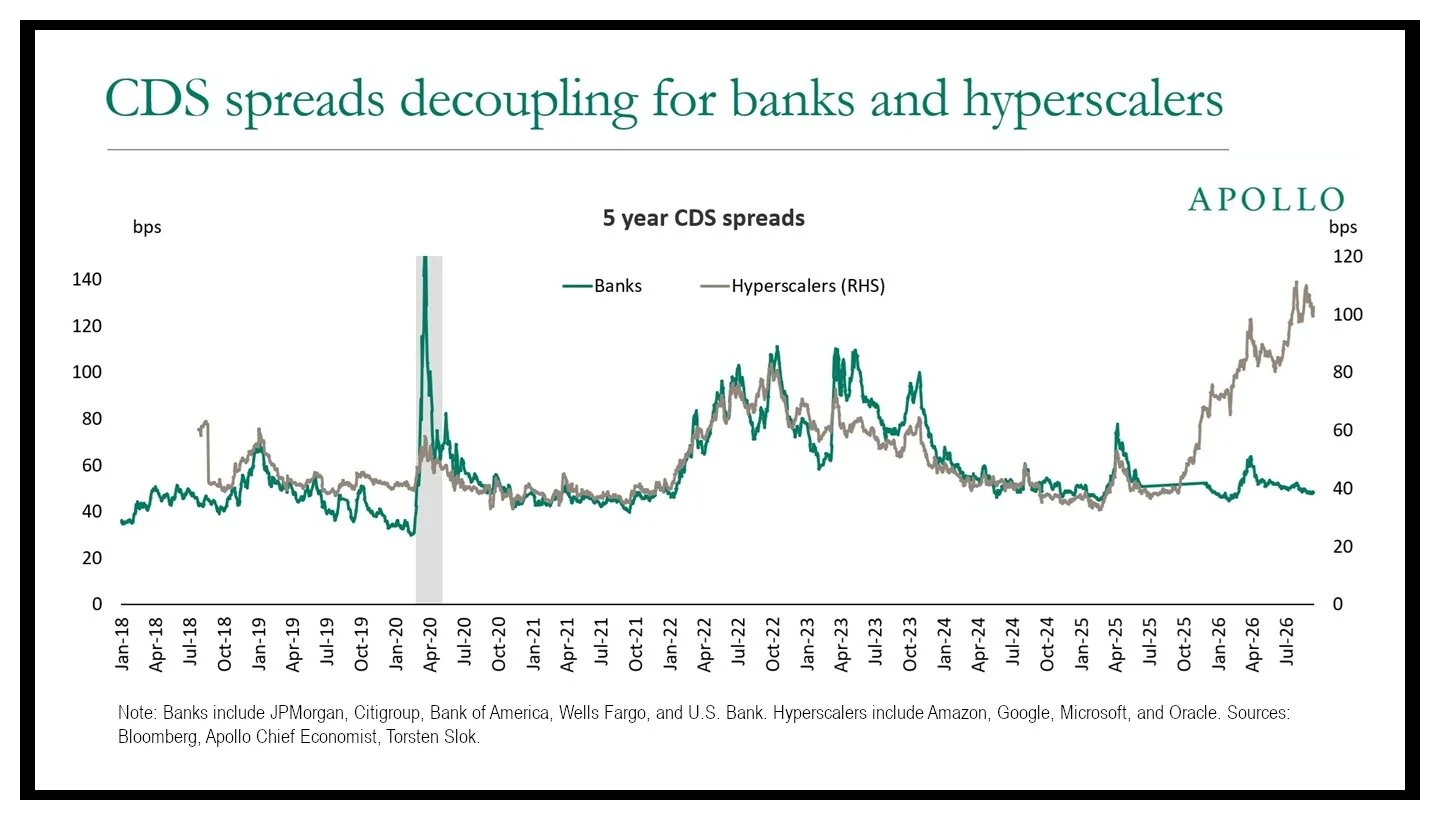
On Wednesday, Torsten Slok, the chief economist at Apollo Global Management, highlighted a concerning trend for the AI trade. The cost of bond insurance (credit default swaps or CDS) is rising rapidly, writes Slok: “What the market is repricing is hyperscaler credit fundamentals, namely a debt-financed AI capex cycle with rising leverage, negative free cash flow and uncertain payback on depreciating assets.”
AI hyperscalers, such as Amazon, Google, Microsoft, and Oracle, have been issuing a massive amount of bonds to fund the AI buildout. Those bondholders often purchase insurance to protect or hedge against default risk—and the cost of that insurance is high.
Source: Apollo Global Management, Inc.
Think of a CDS as an insurance policy on a loan. If a company borrows money and can't pay it back, this insurance policy pays out. When investors get nervous about a company's ability to repay its debt, the cost of that insurance goes up.
The cost to insure the debt of major tech giants just hit an eight-year high. Meanwhile, the cost to insure bank debt has stayed completely flat. If this were just a general market jitter, bank insurance would be rising too. It isn't. The bond market is specifically repricing the risk of Big Tech's AI spending habits.
Borrowing Billions to Build
The stock market loves a good story about future revenue, but the bond market cares about cold, hard cash flow today. Right now, several tech giants are spending significantly more money building AI infrastructure than they are actually keeping from their day-to-day operations.
Alphabet (Google), Amazon, and Meta are currently facing tens of billions of dollars in negative free cash flow as they pour money into AI. Microsoft is a notable outlier, still generating roughly $33.4 billion in positive cash flow with a much lighter debt burden.
To fund this massive gap, these companies are borrowing at a staggering pace. Between 2020 and 2024, the top five tech giants borrowed an average of $28 billion a year in the U.S. bond market. In 2025, that skyrocketed to $121 billion. In just the first few months of 2026, they blew past $150 billion. They are building the AI revolution using other people's money.
The AI infrastructure boom is getting more leveraged—and harder to track because of complex financing structures designed to keep debt off tech companies' corporate balance sheets. Special purpose vehicles (SPVs), which are backed by private credit, institutional investors, and major banks, own massive underlying assets such as land, data centers, servers, computing equipment, and so on, which are then leased to the hyperscalers under long-term contracts.
Borrowing massive amounts of money is common in business, but the type of assets Big Tech is buying makes them uniquely risky. When a utility company borrows money to build a power plant, that plant generates revenue for decades. AI data centers are entirely different. We can’t be sure massive data centers will be needed five or ten years from now. And, while the physical building lasts a long time, the incredibly expensive computer chips inside become outdated in just a few years. Big Tech is taking on massive debt to construct buildings that may not be needed over the long term and to fill them with equipment that depreciates rapidly.
While stock investors are still hanging onto the AI growth story and revenue hype, the financial experts in the weeds are attaching real risk to this AI debt mountain. The tension between the stock market's optimism and the bond market's anxiety won't last forever. The warning light only turns off when these companies prove their AI investments can finally generate more cash than they consume.
What This Means for Investors
While the tech giants are unlikely to go bankrupt, the concerns of bond investors could easily spread to equity investors. With hyperscaler stock prices near all-time highs, a change in investor sentiment could trigger a sell-off ending the AI growth trade. And that sell-off could trigger a broad-based sell-off across many sectors of the economy that are connected to the AI growth story.
For investors who have a significant amount of their portfolio allocated to tech stocks and/or the S&P 500 Index, which is now heavily weighted to the tech sector, this is a perfect time to review your portfolio with a professional risk manager. It may be an ideal time to reduce your exposure to an AI trade that seems to be approaching its final days.
◇ ◇ ◇
Some interesting things I came across this week…
Is the recent media buzz around AI safety and regulation a campaign to block competition? A texbook anti-competitive regulatory push? (Issues & Insights)
Alex Karp, CEO of Palantir, pulled no punches on CNBC sharing his views on AI safety and much more. (YouTube)
“The Bond King,” DoubleLine CEO-CIO Jeffrey Gundlach, reviews the macroeconomic landscape in detail using some great charts and graphs. (YouTube)
Chris Whalen on market uncertainty, why the Fed doesn’t matter and cracks in the private credit market. (YouTube)
Can the developed world comfortably sustain today’s level of real interest rates with debt burdens exceeding 100% of GDP? (Bond Vigilantes)
◇ ◇ ◇
Off the beaten path...
AI world domination soon, but first, ChatGPT-6 needs to learn how to count. (YouTube)
Twelve Spices That Changed the World: Between c. 1450 and 1650, demand for spices and other high-value plant commodities became an important catalyst for European maritime expansion. (World History Encyclopedia)
Messi, Lewandowski and Suárez—3 of the top 10 all-time leading goal scorers in world soccer history—played in the Miami v Chicago MLS match-up on Sept 9. (YouTube)
◇ ◇ ◇
When you're ready, here's how I can help:
Review your investments. Your "buy-and-hope" portfolio presents a serious risk to your retirement plan. I'll review your holdings one-by-one and share ideas for how to de-risk.
Free portfolio analysis. Get a comprehensive portfolio analysis with Portfolio Visualizer, an institutional-grade tool that measures portfolio risk, volatility and diversification gaps.
Free Retirement Planning Tool. I've partnered with ProjectionLab, a simple but detailed financial planning tool that will reduce anxiety around your finances.
Learn how we invest for clients. Every quarter we provide clients with a detailed Investment Outlook that explains exactly how they're invested and why.
Thanks for reading. I'd love to hear from you!
I founded Alpha Rock to provide investors the highest level of personal service. Discover the benefits of working with a solo advisor and contact me directly with your thoughts, questions and feedback.

IMPORTANT DISCLOSURE INFORMATION
This commentary reflects the personal opinions, viewpoints and analyses of the Alpha Rock Investments, LLC employees providing such comments, and should not be regarded as a description of advisory services provided by Alpha Rock Investments, LLC or performance returns of any Alpha Rock Investments, LLC client. The views reflected in the commentary are subject to change at any time without notice. Nothing in this commentary constitutes investment advice, performance data or any recommendation that any particular security, portfolio of securities, transaction or investment strategy is suitable for any specific person. Any mention of a particular security and related performance data is not a recommendation to buy or sell that security. Alpha Rock Investments, LLC manages its clients’ accounts using a variety of investment techniques and strategies, which are not necessarily discussed in the commentary. Investments in securities involve the risk of loss. Past performance is no guarantee of future results.
The S&P 500 Index or the Standard & Poor's 500 Index is a market-capitalization-weighted index of the 500 largest U.S. publicly traded companies. The S&P 500 is a float-weighted index, meaning company market capitalizations are adjusted by the number of shares available for public trading. Note: Investors cannot invest directly in an index. These unmanaged indices do not reflect management fees and transaction costs that are associated with most investments.
Alpha Rock Investments, LLC provides links for your convenience to websites produced by other providers of industry related material. Accessing websites through links directs you away from our website. Alpha Rock Investments, LLC is not responsible for errors or omissions in the material on third party websites, and does not necessarily approve of or endorse the information provided. Users who gain access to third party websites may be subject to the copyright and other restrictions on use imposed by those providers and assume responsibility and risk from use of those websites.