(Mis)Understanding China
Weekly Investment Update | By Brian Schreiner
The prevailing Western narrative on China is fundamentally flawed. It views China through the lens of a failing “command economy” and a manipulated real estate market. These stereotypes are causing investors to miss one of the most significant economic transformations of the 21st century.
Since 2018, China has executed a massive, strategic reallocation of capital—moving away from debt-fueled property expansion and into high-tech industrial self-sufficiency. This transformation, driven by market-based mechanisms and incentives from local and national governments, has created an economy that is outperforming the West in critical sectors like automation, energy, and transportation.
Reflationary Policy Shift
Having secured its industrial base against U.S. sanctions, Beijing is now pivoting to restore consumer confidence. Lawmakers are working to reflate the economy and repair household balance sheets by running significant budget deficits to stimulate demand. Consequently, government spending is projected to remain robust over the coming years.
China is no longer the monolithic “command economy” of the past. Investors have held onto this misconception for too long. Today, the Chinese economy is anything but rigid. After over 40 years of gradual deregulation and reforms across labor, land, and capital markets, the economy has matured and is now driven by dynamic forces and is highly responsive to market signals.
Robust Market Forces & Competition
Local governments aggressively compete to subsidize and foster regional champions. According to Bloomberg, there were 500 EV manufacturers in China in 2019. Today, after several years of fierce competition, only about 100 remain. While this hyper-competition is challenging for corporate margins, it benefits consumers and acts as the engine driving China's rapid industrial upgrades.
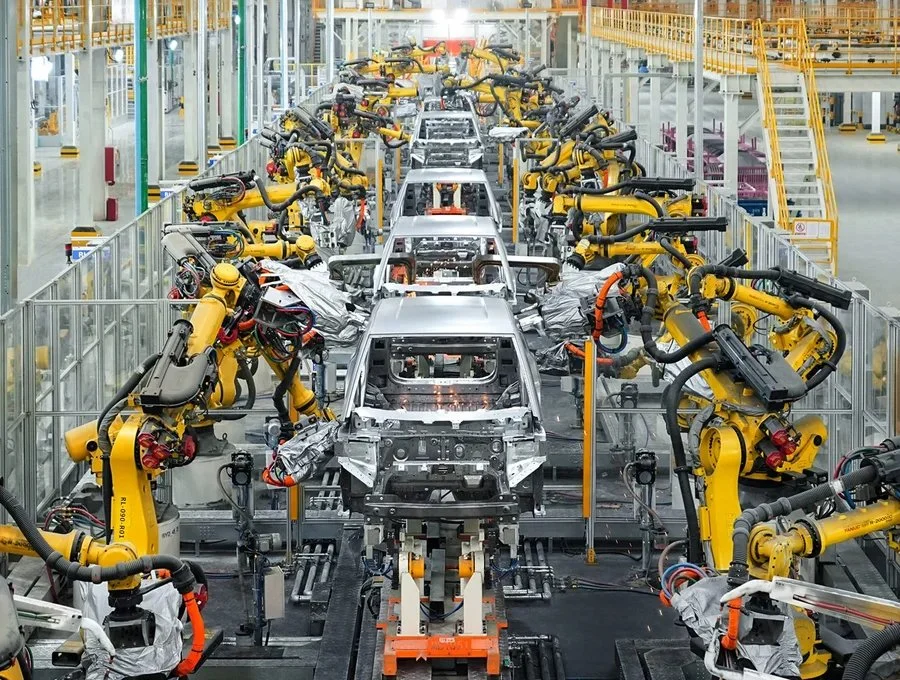
BYD Assembly Line Robots
The combination of cheap capital and a massive surge in labor supply has allowed China to leapfrog Western incumbents. China now graduates roughly 12 million university students annually, providing an army of engineers to execute this industrial vision.
The scale of research and development in China is difficult for Western observers to comprehend. BYD Auto, the world’s largest manufacturer of plug-in electric vehicles (PEVs), started as a battery manufacturer and evolved into a vertically integrated powerhouse producing not just cars, but the batteries, chips, and motors that power them. BYD’s Research & Development Department alone employs nearly 110,000 engineers. By comparison, Tesla’s entire global workforce numbers about 125,000.
World-Leading Tech Innovation
Chinese firms are not just producing cheaper goods; they are producing advanced technology at a fraction of the cost. For example, the BYD Seagull EV retails for about $9,700 in China and is likely to be available in Europe and Canada next year. The Seagull and other similar Chinese EVs have inspired Ford to create its own low-cost EV platform.
Over the past decade, the Chinese firm Hesai reduced the cost of LiDAR (Light Detection and Ranging) technology from $100,000 to $200, making it viable for installation in millions of EVs. LiDAR functions similarly to radar (radio waves) and sonar (sound waves) but produces much higher resolution and greater precision. Such technological advances are creating a competitive moat that protectionist policies will only make deeper and wider.
Furthermore, China produces abundant, relatively cheap energy. China now generates more electricity than the U.S., India, and the EU combined. Massive investments in grid infrastructure have driven energy costs to levels that are a fraction of the West's. In some provinces, energy is effectively free during peak solar hours.
Labor costs in China are significantly lower than the developed world. For apples-to-apples example, the Shanghai Tesla factory produces twice as many cars per worker as its U.S. counterpart in Fremont, with labor costs that are far lower.
Challenging U.S. AI Supremacy
In late August, The Economist published “China is quietly upstaging America with its open models,” arguing that China is challenging American AI supremacy by adopting a strategic "open weights" approach. This contrasts sharply with the closed, proprietary systems of U.S. giants like OpenAI and Google.
While American firms have locked down their models to protect high valuations and safety, Chinese labs such as DeepSeek are flooding the global ecosystem with high-performance, open-source models that rival the capabilities of top-tier U.S. systems like GPT-4.
Andreessen Horowitz estimates that 80% of new AI startups are now building their products on top of Chinese open models rather than American ones, effectively positioning China to set the technical standards for the next generation of global AI applications.
U.S. efforts to stifle China’s progress through tariffs and export controls have backfired, inadvertently forcing Chinese companies to become even more efficient. Denied access to the massive computing power available to Silicon Valley, Chinese labs have achieved world-class results at a fraction of the cost. This efficiency allows Chinese firms to commoditize "intelligence" by offering it for free or at negligible inference costs, thereby undercutting the subscription-based business models of U.S. competitors. While the U.S. focused on maintaining a hardware advantage, China has quietly won the software war, ensuring that the global AI economy increasingly runs on Chinese engines.
In the West, China’s economic transformation from Soviet-style communism to a unique brand of dynamic state capitalism has been vastly underestimated. China has emerged from its 2020 property crisis and built a formidable, high-tech industrial machine. With its stock market still attractively priced and the government actively shifting to reflationary policies, the risk-reward ratio for both Chinese stocks and bonds is compelling.

“If you look at the past four decades, China has lifted 700 million or so people out of abject poverty into a middle-class lifestyle. It's undeniably unprecedented in the history of humanity. My guess is it will never be repeated. It is an amazing story which, frankly deserves all of our attention. In the space of one generation, China has gone from graduating 350,000 university students to graduating 12-13 million university students per year.”
Louis-Vincent Gave, CEO, Gavkal Research on MacroVoices #495: Understanding China's Structural Growth Drivers, Aug 28, 2025

There Are 37% More Home Sellers Than Buyers (Redfin)
Central Bankers Disagree About Gold (Mises Institute)
Polymarket & the wisdom of crowds (60 Minutes)
11 Of The Most Faked Foods In The World (Businss Insider)
Download our Quarterly Investment Outlook
Alpha Rock offers a compelling alternative to traditional buy-and-hold investing by offering active, risk-managed portfolio management services focused on liquid alternative investments and risk management.
To learn more about how we are investing for clients and for our current views on the global investment landscape, download our Quarterly Investment Outlook.
We’d love to hear from you!
Your thoughts are important to us, so don’t hesitate to share them. They give us great motivation and encouragement.

IMPORTANT DISCLOSURE INFORMATION
This commentary reflects the personal opinions, viewpoints and analyses of the Alpha Rock Investments, LLC employees providing such comments, and should not be regarded as a description of advisory services provided by Alpha Rock Investments, LLC or performance returns of any Alpha Rock Investments, LLC client. The views reflected in the commentary are subject to change at any time without notice. Nothing in this commentary constitutes investment advice, performance data or any recommendation that any particular security, portfolio of securities, transaction or investment strategy is suitable for any specific person. Any mention of a particular security and related performance data is not a recommendation to buy or sell that security. Alpha Rock Investments, LLC manages its clients’ accounts using a variety of investment techniques and strategies, which are not necessarily discussed in the commentary. Investments in securities involve the risk of loss. Past performance is no guarantee of future results.
The S&P 500 Index or the Standard & Poor's 500 Index is a market-capitalization-weighted index of the 500 largest U.S. publicly traded companies. The S&P 500 is a float-weighted index, meaning company market capitalizations are adjusted by the number of shares available for public trading. Note: Investors cannot invest directly in an index. These unmanaged indices do not reflect management fees and transaction costs that are associated with most investments.
Alpha Rock Investments, LLC provides links for your convenience to websites produced by other providers of industry related material. Accessing websites through links directs you away from our website. Alpha Rock Investments, LLC is not responsible for errors or omissions in the material on third party websites, and does not necessarily approve of or endorse the information provided. Users who gain access to third party websites may be subject to the copyright and other restrictions on use imposed by those providers and assume responsibility and risk from use of those websites.