Will the Federal Reserve Finally be Reformed?
Weekly Investment Update | By Brian Schreiner
Stocks were mixed last week as bonds edged lower. While commodities generally trended up, the real shockwave hit the precious metals market on Friday. Silver plummeted 30%—its worst single-day drop since 1980—and gold tumbled as the nomination of Kevin Warsh for Fed Chair eased fears about the stability of the dollar. Despite the late-week sell-off, both metals finished January in positive territory.
On Wednesday, the Federal Reserve’s Open Market Committee decided to maintain the federal funds rate at 3.5% to 3.75%. During the subsequent press conference, Claire Jones of the Financial Times asked Chairman Jerome Powell to address the recent decline in the U.S. dollar.
Powell’s response was telling:
“So, Claire, as you probably know, we don't comment on the dollar. Really, the Administration and especially the Treasury Department has the job of oversight over the currency... It's not our role. So, I have nothing for you.”
This is a startling admission. The Federal Reserve’s primary Congressional mandate is to maintain price stability—which is, by definition, managing the purchasing power of the dollar. For the Chairman to claim the currency isn’t "his role" is like a meteorologist refusing to comment on the weather.
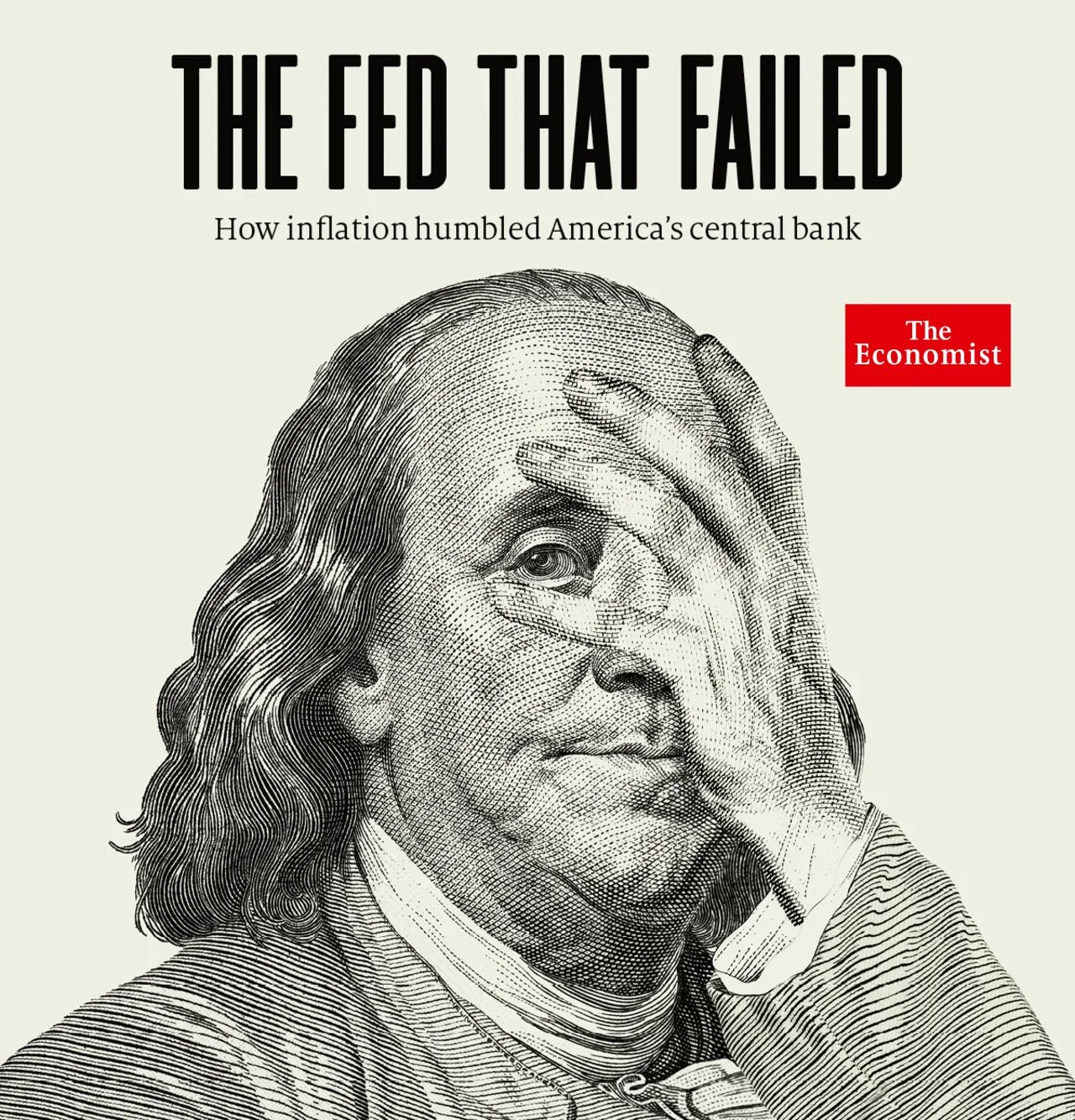
Cover of The Economist magazine April 23, 2022
Fundamental Flaw
Why does the Fed avoid discussing the currency they are tasked to manage? Because the current leadership is steeped in Keynesianism. They treat inflation as a "temperature" problem—a symptom of the economy running too hot.
As Monetarists like Milton Friedman correctly explained, inflation is a supply problem—specifically, the supply of too much money. By ignoring the money supply and focusing on "fine-tuning" demand, the Fed has become unhinged from reality, leading to the many policy failures we’ve seen in recent decades.
A Legacy of Distortions
Some of us recognised that the Fed was working on misguided fundamentals years ago, when they held interest rates near zero for a decade—even during long periods of strong economic growth. (The Fed held interest rates between 0%–0.25% for a total of nearly 10 years across two distinct periods: December 2008 to December 2015, and again from March 2020 until March 2022.) Others took notice during the inflation spike of 2021–2022 when prices were rising over 9% annually. Unfortunately, most financial professionals and the media continue to ignore their policy mistakes and the devastating for the average Americans:
The Wealth Gap: Asset price bubbles benefitted Wall Street while punishing savers and middle-class families.
The K-Shaped Economy: The working-class have been squeezed by persistently high inflation—including a 9% inflation spike in 2021-2022—while the middle class saw the purchasing power of their wages evaporate.
Currency Debasement: The purchasing power of the U.S. dollar has declined by 52% over the past 25 years—an average annual inflation rate of about 3%, persistently above the Fed’s supposed “target” of 2%.
Kevin Warsh: Architect of Reform?
On Friday, when President Trump announced that his nomination to succeed Jerome Powell will be Kevin Warsh. Gold and silver prices reacted instantly because the markets recognize that Warsh represents regime change at the Fed.
A former Fed Governor and current fellow at Stanford’s Hoover Institution, Warsh has been a vocal critic of the Fed’s institutional drift. The Fed has wandered too far into fiscal and social policy—even attempting to address climate change with its regulatory policies—while losing sight of its essential mandate: price stability.
In a recent interview with Peter Robinson on Uncommon Knowledge, Warsh described the post-2008 era as "the complacency era," where the Fed became addicted to crisis tools like Quantitative Easing (QE). He says the 2021 transitory narrative, “the greatest mistake in macroeconomic policy in 45 years.”
Warsh believes the elevated inflation we’re seeing now is an echo of the “Great Inflation” of the 1970s. Pandemic stimulus, QE-to-infinity and institutional "drift" has led them to ignore the money supply, which is the true driver of inflation that has widened the wealth gap and driven the affordability crisis.
Warsh will face many challenges to his objectives, but when he takes over Fed leadership in May, he’s going to work to reduce inflation, shrink the Fed’s balance sheet and restore public trust in the institution and the dollar.
Many well respected voices have come out in support of Warsh, including the Wall Street Journal Editorial Board: “Mr. Warsh has an extraordinary opportunity to reform the Fed so it resumes its role as a steward of price stability to underpin stable growth and rising incomes.”

“Inflation is a choice.”
~ Kevin Warsh, President Trump’s nominee to succeed Jerome Powell

BlackRock Private Credit Fund Taking Losses (Morningstar)
Japan’s Bond Crash Sends Shockwaves Through Markets (Bloomberg)
FAA Chief Accepts Failures in Deadly Mid-Air Collision (Reuters)
The Theif Collector: The greatest art heist you’ve never heard of (YouTube)
Download our Quarterly Investment Outlook
Alpha Rock offers a compelling alternative to traditional buy-and-hold investing by offering active, risk-managed portfolio management services focused on liquid alternative investments and risk management.
To learn more about how we are investing for clients and for our current views on the global investment landscape, download our 2026 Investment Outlook.
We’d love to hear from you!
Your thoughts are important to us, so don’t hesitate to share them. They give us great motivation and encouragement.

IMPORTANT DISCLOSURE INFORMATION
This commentary reflects the personal opinions, viewpoints and analyses of the Alpha Rock Investments, LLC employees providing such comments, and should not be regarded as a description of advisory services provided by Alpha Rock Investments, LLC or performance returns of any Alpha Rock Investments, LLC client. The views reflected in the commentary are subject to change at any time without notice. Nothing in this commentary constitutes investment advice, performance data or any recommendation that any particular security, portfolio of securities, transaction or investment strategy is suitable for any specific person. Any mention of a particular security and related performance data is not a recommendation to buy or sell that security. Alpha Rock Investments, LLC manages its clients’ accounts using a variety of investment techniques and strategies, which are not necessarily discussed in the commentary. Investments in securities involve the risk of loss. Past performance is no guarantee of future results.
The S&P 500 Index or the Standard & Poor's 500 Index is a market-capitalization-weighted index of the 500 largest U.S. publicly traded companies. The S&P 500 is a float-weighted index, meaning company market capitalizations are adjusted by the number of shares available for public trading. Note: Investors cannot invest directly in an index. These unmanaged indices do not reflect management fees and transaction costs that are associated with most investments.
Alpha Rock Investments, LLC provides links for your convenience to websites produced by other providers of industry related material. Accessing websites through links directs you away from our website. Alpha Rock Investments, LLC is not responsible for errors or omissions in the material on third party websites, and does not necessarily approve of or endorse the information provided. Users who gain access to third party websites may be subject to the copyright and other restrictions on use imposed by those providers and assume responsibility and risk from use of those websites.